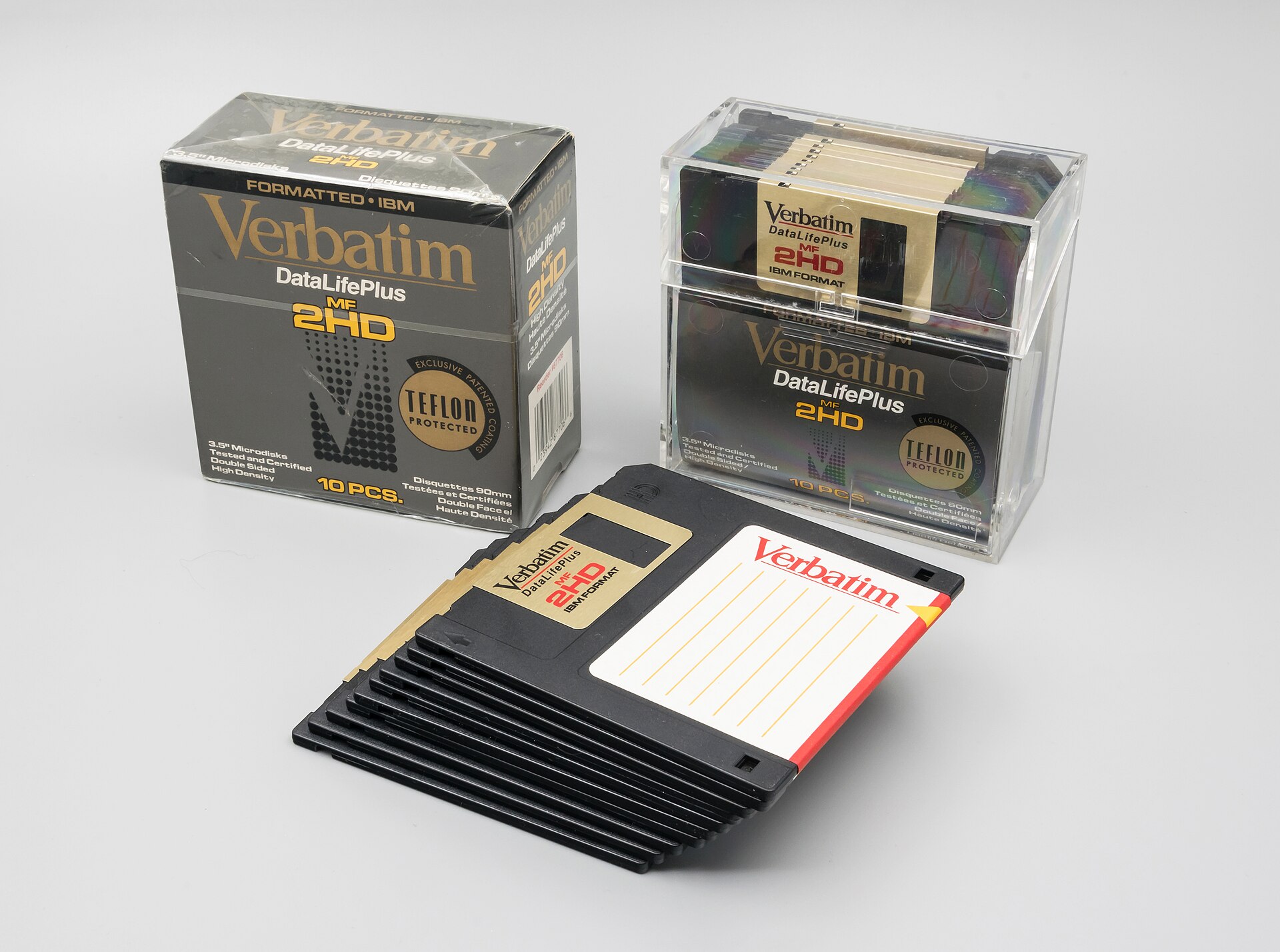

A handwritten label could turn a small plastic disk into something unusually important. Homework. Budget. A story you were writing. The contents were invisible, but the label gave them a physical place in the world. You could hold your work, misplace it, lend it, or carefully put it away.
A name that outlasted its shape
The Computer History Museum dates IBM’s first floppy-disk drive to 1971. Its eight-inch disk held about 80 kilobytes. Later formats changed the size and packaging; the 3.5-inch disks pictured here came in rigid cases. The word “floppy” remained even when the object in your hand no longer seemed to match it.
For a home-computer user, the interesting part was not always the engineering. It was the possibility of moving something from one machine to another, or keeping a copy outside the computer itself. A file could leave the desk with you.
The label was your search box
A collection of disks invited its own system. Neat labels, crossed-out titles, a box divided into categories, or a pile that only its owner understood. Finding something could mean reading every label and trying to remember which version was the one you wanted.
Making another copy required a decision. So did choosing what to keep when space ran short. Those small acts made storage visible. Today it is possible to accumulate files without ever picturing where they sit; a disk collection gave the accumulation edges and a weight.
A small object with a long afterlife
The floppy survives in familiar save-button imagery, even for people who have never used one. For someone who did, the shape may carry a more specific memory: a classroom computer, a first job, or a project carefully brought home. Technology moves on, but an ordinary object can keep its connection to the work—and the person—you were at the time.
What was written on the most important disk in your collection?
Sources & further reading
Written with AI assistance. Historical details checked against the linked sources. Our editorial approach